










Deep strikes are reaching further, strengthening Ukraine's positions
Kyiv • UNN
In recent months, the Armed Forces of Ukraine have been systematically striking Russian oil refineries and ports on the territory of the Russian Federation at distances of up to 1,700 km. Drone strikes are causing significant damage to the aggressor's economy.

"Russians do not like our drones and missiles," emphasized President of Ukraine Volodymyr Zelenskyy in his open letter to the Russian dictator Vladimir Putin. And this is obvious, as Ukrainian drone strikes are pushing deeper into Russia, becoming increasingly painful and causing significant damage. UNN has compiled for you the most striking strikes carried out by our fighters on enemy territory, starting from May 1.
May started off hot – the Unmanned Systems Forces reported that Ukrainian drones paid a visit to the Russian city of Tuapse.
This was not the first attack on the Tuapse oil refinery.
The systematic destruction of the Russian Federation's oil refining industry facilities is part of a strategy to reduce the enemy's capability to wage war against Ukraine
On the night of May 3, Russian authorities reported a massive drone attack in the Leningrad region. The port of Primorsk—the largest oil loading port of the Russian Federation on the Baltic Sea—came under fire.
And as early as the night of May 4-5, a "Flamingo" missile manufactured by Fire Point struck "VNIIR-Progress," which produces "Kometa" navigation modules for drones and missiles. The plant is located 1,150 kilometers from the border with Ukraine.
That same night, the "Kirishinefteorgsintez" refinery in the city of Kirishi, approximately 870 km from the Ukrainian border, came under attack. A previous April strike on the "Kirishinefteorgsintez" refinery caused a large fire and the suspension of all production operations. The plant processed 17.5 million tons of oil per year—6.6% of total Russian refining.
On May 5, guests were "welcomed" by the fourth-largest refinery in the Russian Federation, "Lukoil-Nizhegorodnefteorgsintez" in Kstovo, 830 km from the border. Strikes on this enterprise did not stop—there were at least 3 waves during May.
On May 7–8, the Perm refinery "Lukoil-Permnefteorgsintez," 1,500 km from the border, was hit. The Perm refinery completely stopped oil refining after the attack and fire—three main primary processing units were shut down.
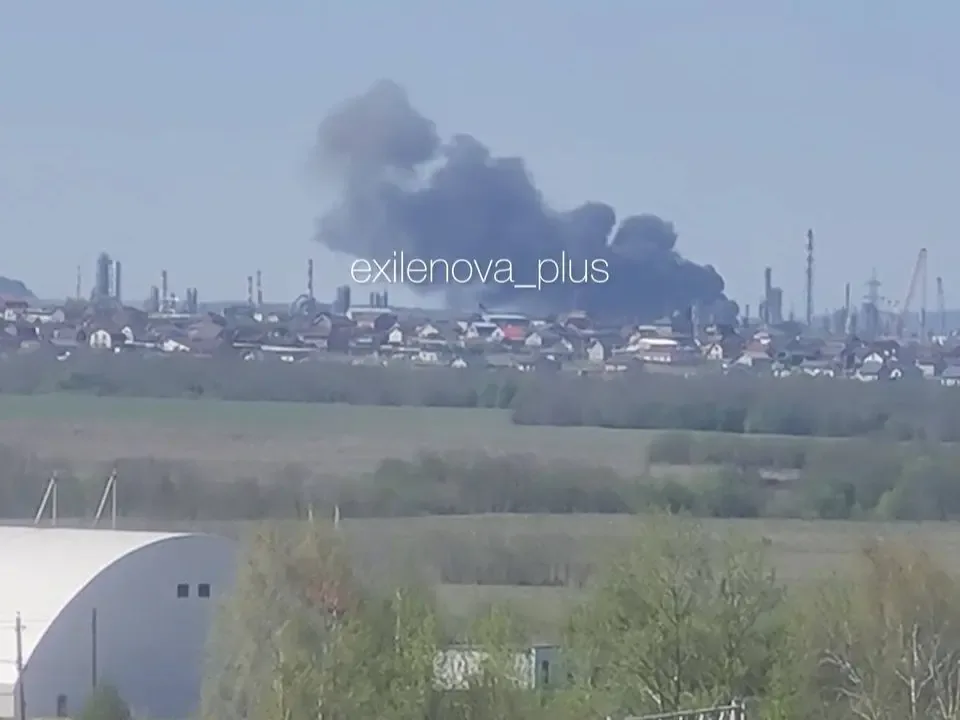
On May 8, the Yaroslavl refinery and the "Yaroslavl-3" oil pumping station, 680 km from the border, came under fire. A fire broke out at the enterprise.
On May 13, the "Astrakhansky" gas processing plant in Astrakhan, 820 km from the border, caught fire. Later, media confirmed the suspension of production.
On May 15 – the Ryazan refinery was also forced to suspend operations after an attack by Ukrainian drones.
On May 21, the AVT-6 unit, which provides over 70% of the capacity of the Syzran refinery, was damaged.
On May 23, Ukrainian drones attacked the chemical plant "Metafrax Chemicals" in Gubakha, Perm Krai.
On May 23, the targets of the strikes were the "Sheskharis" oil terminal and the "Grushovaya" oil depot in Novorossiysk, 420 km from the border. This was already the third strike on this area.
May 29 – the Volgograd "Lukoil" refinery, 480 km from the border. After a Ukrainian drone strike on May 29, the Lukoil refinery in Volgograd stopped oil refining.
May 30–31 - the Saratov refinery and the "Lazarevo" linear production and dispatch station in Saratov, 630 kilometers from the border.
And this is only part of the damage. According to analysts, Ukraine mostly uses FP-1 drones manufactured by Fire Point for strikes deep into the Russian Federation.
The most illustrative were the strikes on Moscow and the Leningrad region.
Strikes on Moscow and the region were carried out on the night of May 17. According to the General Staff of the AFU, three types of strike drones were involved in the attack:
- FP-1 Firepoint
- RS-1 Bars
- Bars-SM Gladiator.
The drones managed to push through the air defense of the most protected region of the Russian Federation.
But the strike on the Leningrad region became, perhaps, even more symbolic.
The AFU attacked the Kronstadt base and the oil terminal in Saint Petersburg with drones on the opening day of the St. Petersburg International Economic Forum, where the entire Russian political elite, including dictator Vladimir Putin, had gathered. The strikes on the targets were carried out by FP-1 drones.
The Institute for the Study of War noted that since March of this year, Ukrainian forces have significantly increased the frequency, range, and intensity of strikes on oil infrastructure in Russia's deep rear. This is causing colossal damage to the Russian oil industry.
Thanks to such devastating strikes, Ukraine gets a chance to speak with Russia from a position of strength. Currently, according to the General Staff of the AFU, the military was able to hit a target at a distance of 1,700 kilometers deep into enemy territory. But it is quite likely that soon we will learn about strikes at even greater distances, or see an even more large-scale attack on Moscow.