










Emotions versus expert opinions: can a photo with a patient justify a doctor in court?
Kyiv • UNN
The defense team for Dr. Vitaliy Rusakov, in the case concerning the death of patient Adnan Kivan, cites joint photos of the doctor and patient and their personal correspondence as arguments to refute the accusation of medical negligence. At the same time, medical law experts emphasize that such arguments are not decisive for a court, which evaluates the doctor's actions based on medical standards, documentation, and expert conclusions.

In the Primorsky District Court of Odesa, during the consideration of a medical negligence case that could have caused the death of patient Adnan Kivan, the defense of doctor Vitaliy Rusakov focused on emotional arguments, trying to cast doubt on the prosecution's version of possible medical negligence. Do such arguments have legal force in similar cases, read in the UNN material.
In the opening statement, the lawyers of one of the accused doctors, Vitaliy Rusakov, stated that he could not have been "negligent" towards the patient, as there were allegedly trusting relations between them. As proof of this, photos from the celebration of Dr. Rusakov's wedding in 2023 were shown in court, where he poses with Kivan.
Separately, the lawyer quoted correspondence between Adnan Kivan and Vitaliy Rusakov, emphasizing that a few days before his death, the patient thanked the doctor for his attention.
"The patient, 4 days before his death, is very grateful: 'Thank you very much for your attention to me.' We will refute the prosecution's version of the doctor's indifference, because Rusakov was in daily contact with his patient. And the patient was grateful," one of Rusakov's lawyers noted in his opening statement.
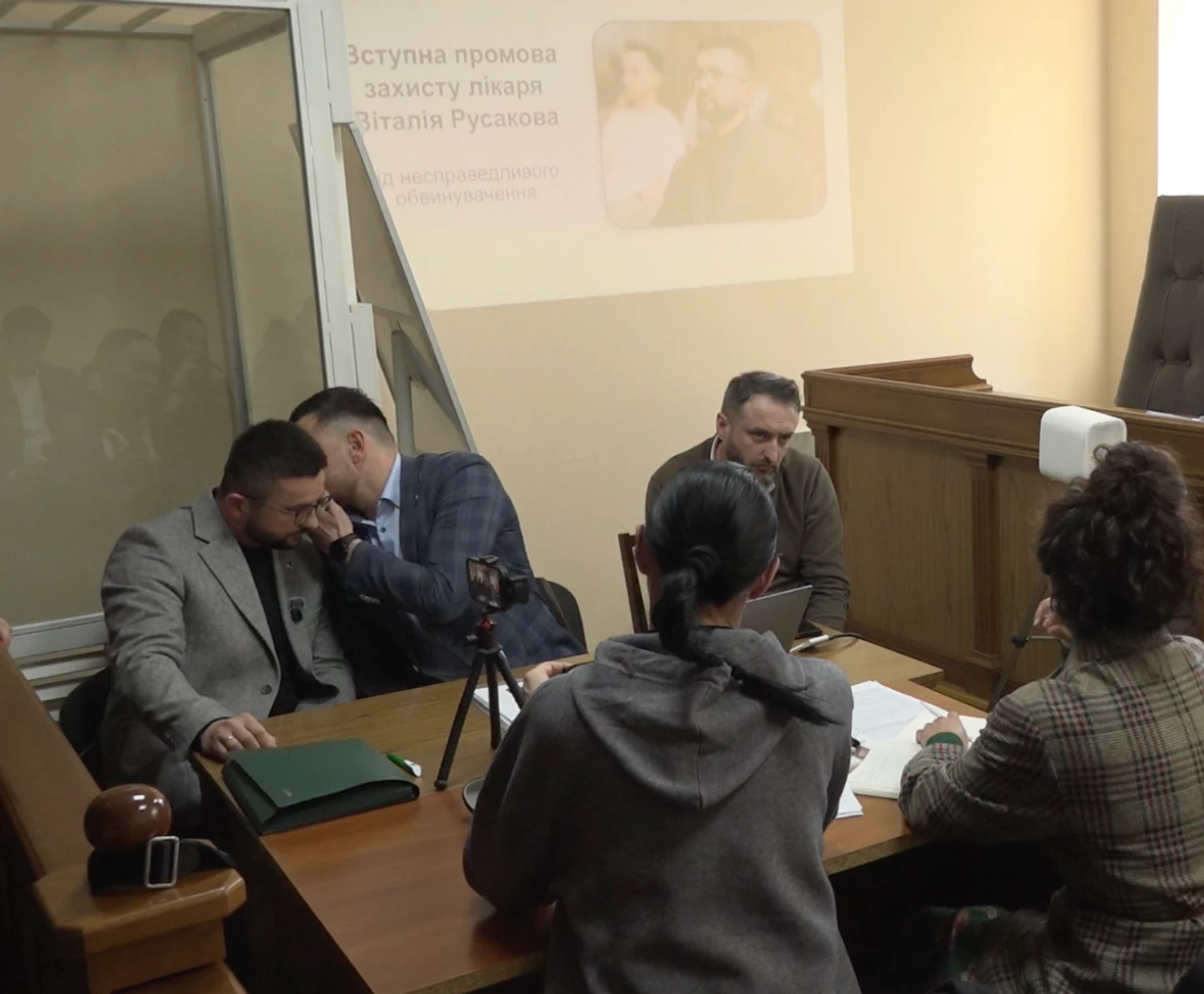
According to the defense, such messages refute claims of possible negligence.
However, medical law experts emphasize that such arguments do not have decisive legal significance in medical negligence cases. This is rather an element of a public or emotional defense line than proof of proper medical care.
As medical lawyer Dmytro Kasyanenko explains, the assessment of a doctor's actions in criminal proceedings is based not on the subjective perception of the patient, but on objective criteria.
"The patient's gratitude to the doctor itself does not have decisive legal significance for the conclusion about the absence of medical negligence. In such cases, the court ascertains not whether the patient was satisfied with communication or treatment at a certain moment, but whether professional duties were properly performed, whether the doctor's actions complied with medical standards and clinical protocols, and whether there is a causal link between the medic's actions or inaction and serious consequences," the medical lawyer explained.
According to Dmytro Kasyanenko, in similar cases, medical documentation, examination results, prescription records, as well as the conclusions of forensic medical examinations, which provide answers to specific questions regarding the quality of treatment, play a key role.
"Thanking does not mean that the assistance was provided properly. The patient assesses his condition subjectively, often emotionally, and is not obliged to have special knowledge to understand whether diagnostic, tactical, or therapeutic errors were made, the consequences of which appeared later. In court, medical documentation, examination records, prescriptions, examination results, adherence to protocols, and, as a rule, an expert's conclusion will be of key importance," Kasyanenko emphasized.
The use of private correspondence, personal photos, and an appeal to the patient's gratitude demonstrate an attempt to shift the focus from professional standards to an emotional perception of the situation. However, judicial practice shows that in medical negligence cases, the decisive factor is not the nature of the relationship between the doctor and the patient, but the compliance of the medic's actions with established standards and the presence of a causal link with the consequences.
Recall
This refers to the criminal proceedings regarding the death of Odesa businessman Adnan Kivan during treatment at the private clinic Odrex. The accused are surgeon Vitaliy Rusakov and oncologist Maryna Belotserkovska, who are being tried under Part 1 of Article 140 of the Criminal Code of Ukraine - improper performance of professional duties by a medical worker, which could have caused the patient's death. According to the investigation, after the operation, the patient was not prescribed the necessary antibacterial therapy and complications were not properly responded to, which led to the development of sepsis. The accused do not admit guilt, the next court hearing is scheduled for May 5, 2026.