










Masks, social distancing, and deaths on board – how passengers of the MV Hondius are living amid a hantavirus outbreak
Kyiv • UNN
Three people have died on board the MV Hondius due to a hantavirus outbreak. Five Ukrainians are among the crew, and the liner is currently en route to Spain.

There are five Ukrainians on board the cruise liner MV Hondius, where an outbreak of the dangerous hantavirus has been detected, which has already claimed the lives of three passengers. All of them are crew members.
UNN has gathered everything known about the hantavirus, the vessel where the serious infectious disease manifested, and its first victims.
Hantavirus on board the MV Hondius: a chronology of events
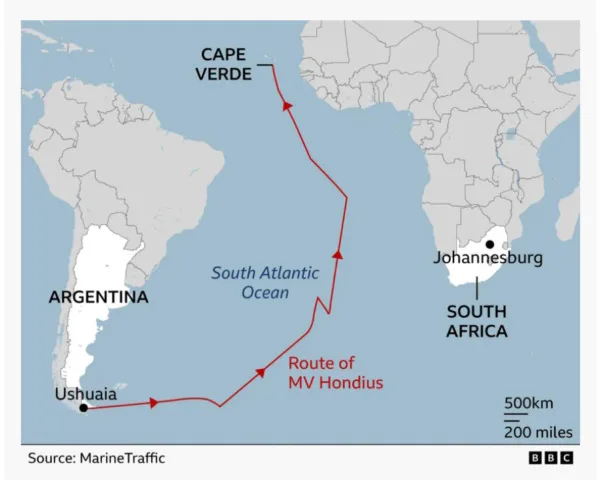
The MV Hondius was scheduled to make a week-long polar cruise. The liner departed from Argentina on April 1 for Antarctica and several isolated islands in the South Atlantic. There were 170 passengers and 71 crew members on board.
Among them, as reported to the media by Kiki Hirschfeldt, a representative of Oceanwide Expeditions, which owns the vessel, were:
- 5 Ukrainians;
- 1 Russian;
- 8 Dutch subjects;
- citizens of Spain, France, Great Britain, and the USA
The first victim of the hantavirus was a 70-year-old Dutchman who died on April 11. For almost two weeks, his body "traveled" on the liner along with other passengers and crew members until the body was removed from the vessel near the shores of Saint Helena (an island of volcanic origin located in the Atlantic Ocean - ed.).
His 69-year-old wife also disembarked from the tourist liner and flew by plane from Saint Helena to South Africa. She lost consciousness at the Johannesburg airport and died in the hospital on April 26.
Meanwhile, the ship with tourists on board continued its journey. It headed for Ascension Island (a volcanic island located in the Atlantic Ocean 1,600 km west of the African coast - ed.). Then another patient appeared among the passengers - a Briton. He was taken and sent by plane to a hospital in South Africa.
The next victim of the illness was a German woman. She died on board the ship on May 2.
By the time the liner approached the coast of Cape Verde in West Africa, two crew members also required medical assistance.
Fearing the spread of infection, passengers and crew members were not allowed to go ashore at the port of Praia. Medics examined them directly on board the liner. Three of the sick were allowed to be evacuated. The people will be sent to the Netherlands to receive medical care there.
As of May 6, it is known that the shipping company has requested permission to dock the liner with the hantavirus outbreak in Tenerife on May 9. The vessel will dock there to disembark all passengers from the liner and evacuate them by plane.
Hantavirus outbreak among tourists: what the WHO says
WHO representatives stated that the hantavirus was likely brought onto the vessel by a passenger who had contact with a rat or an infected person immediately before boarding the liner.
In turn, Argentine authorities reported that at the time of the vessel's initial departure, none of the passengers showed symptoms of hantavirus.
How the passengers of the MV Hondius liner are living now
There are currently passengers from over 23 countries on board the vessel.
Jake Rosmarin, a travel blogger from the USA, admitted in his blog on a social network that all he dreams of is having a bit more information, knowing his future fate, and returning home as soon as possible.
"There is a lot of uncertainty, and that is the hardest part. All we want now is to feel safe, have clarity, and go home,"
Unlike Rosmarin, another passenger of the ship who spoke with BBC journalists said that the entire hantavirus situation is exaggerated. Kasem Hato says he is not panicking and is enjoying reading and watching movies.
Another passenger, who wished to remain anonymous, said that the cruise liner staff asked everyone on board to maintain social distance, wear masks indoors, and sanitize their hands frequently. At the same time, the crew is doing everything to provide people with normal food and entertainment.
What will be the future fate of the passengers and crew members of the liner
On May 5, the WHO appealed to the Spanish government with a request to accept the MV Hondius vessel in the Canary Islands. The information was released and confirmed on the official website of the Spanish Ministry of Health.
Currently, European specialists are checking the passengers and crew of the MV Hondius to determine who needs urgent evacuation while still in Cape Verde due to the risk of hantavirus infection. Other people on board will continue the voyage to the Canary Islands. The vessel is expected to arrive there in 3-4 days, but it is not yet known at which specific port.
When people go ashore, all passengers and crew members will be examined by medics. If necessary, they will be treated, after which they will be helped to return to their homelands.
It is known that all medical procedures and transportation will be carried out in specially prepared locations and vehicles to prevent contact with local residents and protect medical workers.
The Spanish government responded to this request with consent. However, Fernando Clavijo, the head of the regional government of the Canary Islands, has already spoken out against it.
What is known about the liner where the hantavirus outbreak occurred
The MV Hondius is an expedition vessel named after the Flemish engraver and cartographer Jodocus Hondius. Its construction began in 2017 at the Brodosplit shipyard in Croatia.
The owner of the liner is the Dutch company Oceanwide Expeditions. It specializes in expeditionary travel to Antarctica and the Arctic. The company owns and operates a fleet of ice-strengthened vessels. Oceanwide offers small-scale tours where passengers can have close contact with polar wildlife, enjoy landscapes, and visit historical sites.
The MV Hondius is a five-deck liner, 107.6 meters long, 17.6 meters wide, and with a draft of 5.7 meters. It is equipped with two 12-cylinder diesel engines, allowing it to reach speeds of up to 28 km/h. It can accommodate 196 passengers and 72 crew members in 82 cabins.
What you need to know about hantavirus
Hantavirus is a disease transmitted by rodents that can cause life-threatening respiratory complications. Infection usually occurs after contact with the droppings or urine of infected rodents. Human-to-human transmission of the virus is rare.
But in the case of the cruise liner passengers, media citing the WHO write about infection with a strain of hantavirus called Andes. This is one of the most dangerous types of hantaviruses, prevalent mainly in Argentina and Chile. It causes cardiopulmonary syndrome—a severe disease that affects the lungs and can lead to respiratory failure.
The main symptoms are high fever, severe weakness, muscle pain, cough, and shortness of breath. In severe cases, the patient's condition can deteriorate sharply within a few days.
The main feature of the Andes virus is that it is one of the few hantaviruses that can be transmitted from person to person during close contact. Most other hantaviruses are transmitted only through contact with the secretions of infected rodents.
According to medical data, the mortality rate for Andes virus infection can reach 30-40%.
Reminder
The WHO assessed the threat of an epidemic due to the hantavirus outbreak on the liner in the Atlantic. They noted that the risk of an epidemic for the general public remains low after the suspected hantavirus outbreak on board the Dutch cruise ship in the Atlantic Ocean.