










Who should control the use of urban land and why violations can go unnoticed for years
Kyiv • UNN
Land control is carried out by local authorities and Derzhheokadastr, but blurred powers and new laws complicate the response to violations. Due to an ineffective system, communities lose money. The possible "land scheme" under the Odrex clinic in Odesa clearly demonstrates the problem.

In Ukraine, control over the use of urban land is exercised by: local authorities, the State Service for Geodesy, Cartography, and Cadastre, as well as other state structures – in particular, the environmental inspection and architectural and construction control bodies. At the same time, the prosecutor's office, as a law enforcement agency, responds to violations and represents the interests of the state in court. Despite this, cases of land use for unintended purposes or non-transparent decisions can remain without proper reaction for years. Why the land resource control system fails and who is responsible for it, read in the UNN material.
In Ukraine, land can be used for unintended purposes for years, and this will not always have consequences. Despite the presence of several control bodies, the system often does not work in time. As experts explain, the problem lies not only in possible abuses but also in the very model of power distribution among different bodies, which in some cases actually blurs responsibility.
In an exclusive comment to UNN, Rostyslav Kravets, a lawyer and partner at the Kravets and Partners law firm, noted that formally, land use control is assigned to several structures, but in practice, this system does not always work effectively.
First of all, such duties are assigned to the city council, to the city self-government bodies, which should control the proper use of land. And also, recently, the position of the Grand Chamber of the Supreme Court was changed once again, and it was stated that outside the city, land should be controlled by the StateGeoCadastre. Although earlier, and in fact, according to the requirements of the law, the StateGeoCadastre should control the proper use of land for its intended purpose within settlements as well. But in the Grand Chamber at that time, probably due to the air temperature, wind direction, or simply the interest of certain individuals in the decision, it was decided that the StateGeoCadastre was allegedly limited in its right to appeal to the court.
At the same time, the prosecutor's office takes over control of land resources, but its participation in such cases requires separate justification. The expert also draws attention to legislative changes that effectively complicate challenging the illegal acquisition of land if more than 10 years have passed since its transfer.
It is worth considering that last year, amendments were made to the relevant laws, which I consider unconstitutional, but as of today, they have not been challenged in the Constitutional Court. They state that if a land plot was obtained illegally and with violations, but if 10 years have passed since its "acquisition" – then, in fact, no body can file a lawsuit to declare the transfer of this land plot illegal, which generally leads to certain absurdities. This is what NABU should be dealing with.
However, the problem of municipal land use has not only a legal but also an economic dimension. As experts note, every non-transparent decision regarding land resources directly affects community budgets and the quality of life of residents.
A telling example in this context is the situation under close scrutiny by law enforcement agencies in Odesa. This concerns a land plot at Rozkydailivska Street, 69/71, where the main building of the private clinic Odrex is located. The plot, with an area of 1.4931 hectares, belongs to LLC "Fabryka "Akatsiya". According to classification 11.02, its intended purpose is for the placement and operation of main, auxiliary, and ancillary buildings and structures of processing, machine-building, and other industrial enterprises. At the same time, since 2012, a medical institution has been operating on this territory, renting premises from LLC "Fabryka "Akatsiya".
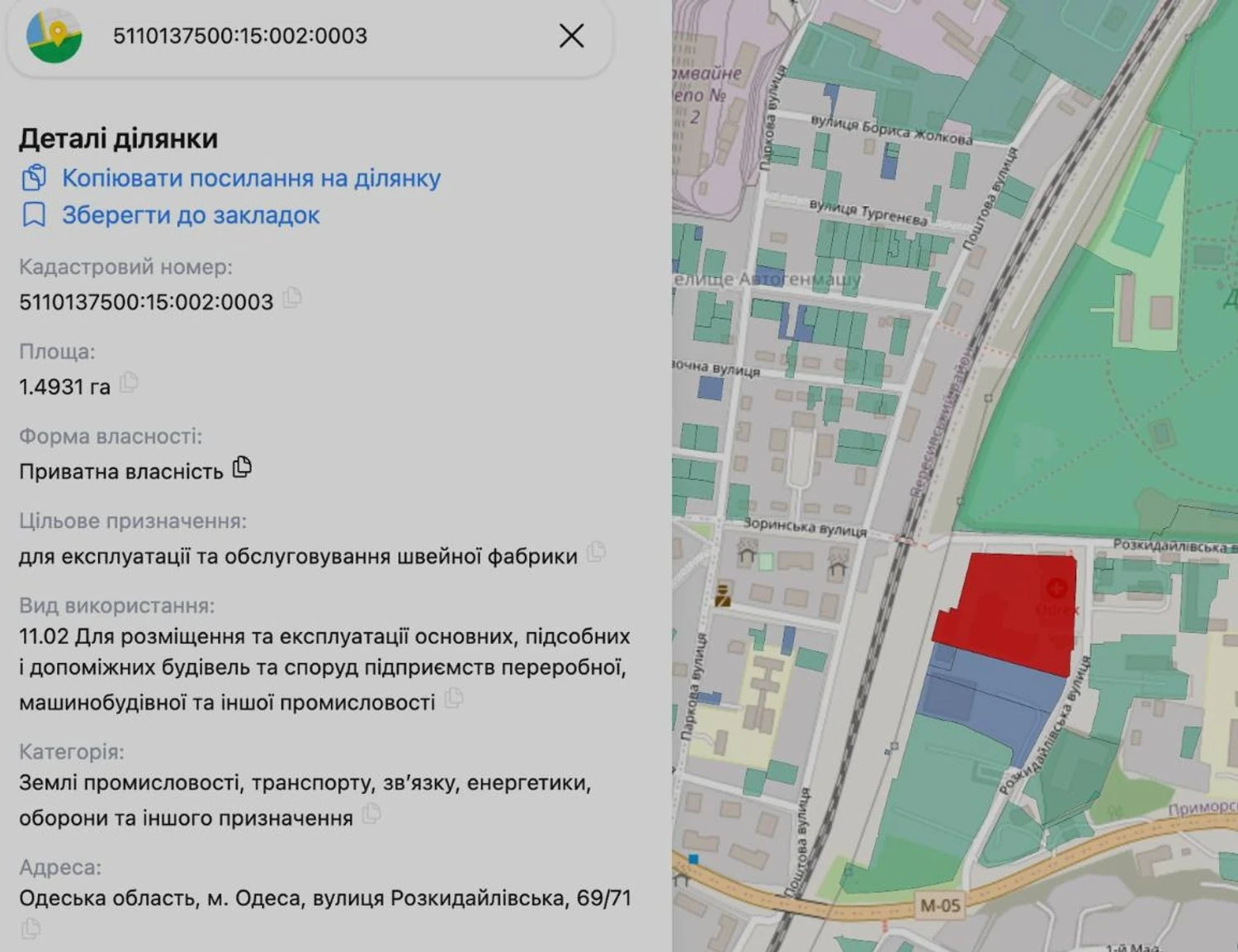
Law enforcement officers are checking whether there has been an unauthorized expansion of the plot boundaries and changes to state registers without proper legal grounds. In particular, it is being established whether the type of object was legally changed from "industrial buildings" to "healthcare facility buildings."
The ownership structure also attracts special attention. In previous materials, UNN reported that the co-owners of LLC "Fabryka "Akatsiya", which owns the land on Rozkydailivska, 69/71, are Iryna Zaikova, Larysa Mysotska, and Yevhen Savitsky. At the same time, these same surnames also appear among the founders of LLC "Medical House "Odrex" – the legal entity under whose license the clinic operates. Thus, despite the formal demarcation, both the land plot, the real estate, and the medical business operating on this territory are owned by the same individuals.
According to experts, such "schemes" are examples of a systemic problem in controlling urban land. After all, there are formally enough responsible bodies, but in practice, the lack of clear coordination and blurred powers allow such situations to remain without proper assessment for years. Political scientist, director of the Center for Civil Society Problems Vitaliy Kulyk emphasizes that every such "land scheme" hits the living standards of city residents.
"Every illegally transferred hectare of land is a direct blow to the community budget, and therefore to the quality of life of each of us. The logic is simple: urban land is a key economic asset of the community. It should work for the city: be leased through transparent auctions, attract investments, and replenish the budget. But when land is given to "insiders" at reduced prices (and sometimes even for free), the city loses huge amounts of money. And it is precisely this money that is then not enough for the real needs of people. In fact, land corruption turns into a hidden tax for the entire community. Because every illegal scheme is a minus in the budget, which then has to be compensated either by cutting expenses or by delayed development."
Kulyk adds that Odesa is actually one of the "headliners" among Ukrainian cities in terms of the number of land schemes and related scandals.
Odesa, for example, has been mentioned for years among cities where land issues regularly become the subject of criminal proceedings, journalistic investigations, and public scandals. And we are not talking about individual plots, but about entire systems of schemes – with dummy companies, manipulations with cadastral data, and tangled chains of resales. For Odesa business and officials, this means super-profits, and for Odesa residents – broken sidewalks, dilapidated buildings, and a city that is losing its former beauty.
Thus, even with several control bodies, the urban land management system in Ukraine remains vulnerable to abuse. As a result, such cases turn not only into the subject of criminal proceedings but also into direct losses for local budgets. And as long as control mechanisms remain ineffective, city residents continue to pay for these "schemes": with the quality of infrastructure, the level of comfort of life, and lost opportunities for development.