










Linguistic manipulations subdue consumers: certificate, guarantee, official status… Have you checked what is behind these words?
Kyiv • UNN
Advertising often uses words like "official" to create an illusion of reliability. Consumers should be attentive to advertising language and think critically.

In a world of information overload and advertising, consumers often focus on external signs of quality - bright packaging, loud slogans, familiar words like "official" or "guaranteed." Such markers create an illusion of safety and reliability, although in reality they rarely have confirmation. As a result, trust is based not on facts, but on well-formulated advertising promises, writes UNN.
Details
As a means of linguistic manipulation, epithets ("premium", "official"), euphemisms ("alternative version" instead of "copy"), as well as pseudo-certification markers ("recommended by experts") are usually used, which often have no factual basis, but create the impression of credibility."
"Advertising uses linguistic manipulation to shape perception and worldview, using strategies that influence cognition and conceptualization. They create a substitutable reality, influencing values and ideals through psychological persuasion," - notes philologist Olena Olenyuk.
Often, such manipulations are aimed at the segment of technology, in particular smartphones, household electronics, gadgets and accessories, where the consumer expects high quality, official warranty and support from the brand. It is here that the use of the words "official", "guaranteed", "certified" or "European technologies" becomes the most effective tool to influence the choice of users.
The linguistic techniques are illustrated by the example of the start page of the YABLUKA network, which is decorated with a banner with the inscription "network of original equipment." The wording sounds authoritative and creates the impression that the company is an official partner of the manufacturer. However, legally, the concept of "original" is not equal to "official": it is only an indication of the true origin of the goods, and not of the licensed supply channel or the availability of a certified service.
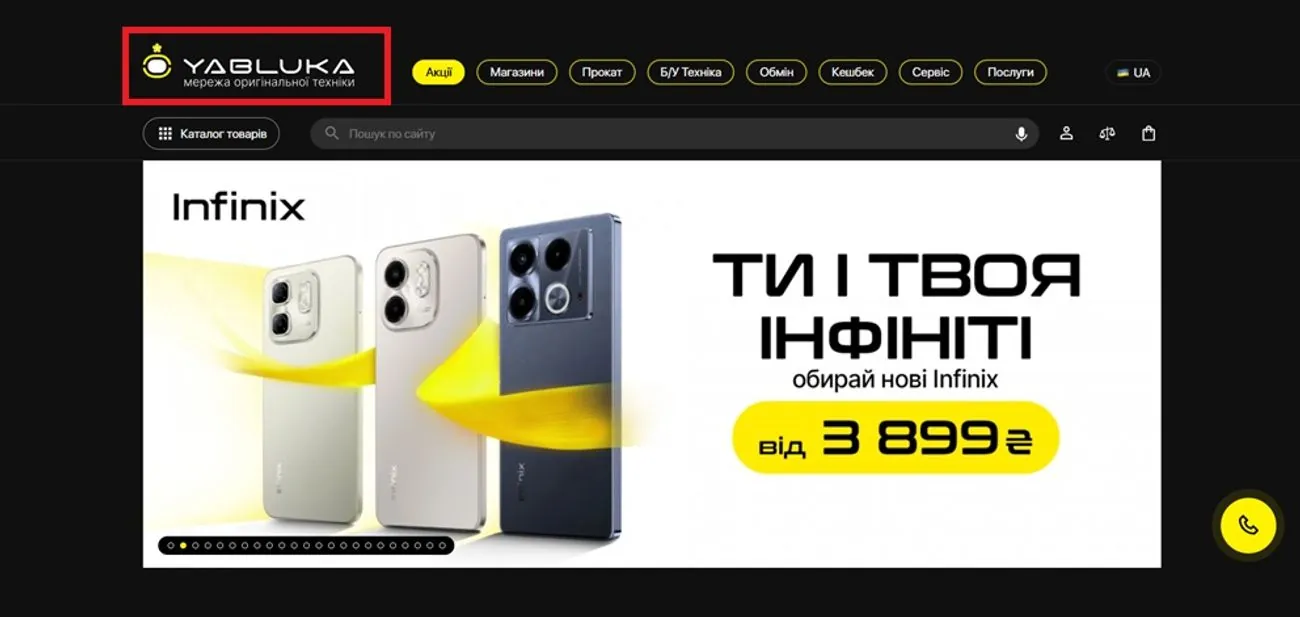
Against the background of news that the Yabluka network has repeatedly been in the field of view of law enforcement agencies due to possible trade in "gray" equipment, and the State Tax Service of Ukraine recorded schemes of evading VAT payment for more than UAH 286 million in the "Yabko" and Yabluka networks, particular attention should be paid to the possible manipulation of advertising technologies and linguistic wordplay, which creates a false impression of the official nature and reliability of the product among consumers.
Among the common language traps designed to inspire confidence in the product are phrases such as "certified product", which sound convincing, but usually do not contain any clarification regarding the origin or validity of the certificate in Ukraine. "Warranty of 12 months" works similarly, which often means only the seller's internal obligation, and not official support from the manufacturer. The wording "service in Ukraine" may hide unauthorized workshops, and "recommended by the manufacturer" may turn out to be an unfounded appeal to authority without evidence. All these expressions create an illusion of reliability, although in reality they are examples of linguistic manipulation based on vagueness and unconfirmedness.
It is interesting that the practice of the European Union to combat manipulative advertising has long been enshrined at the regulatory level. In particular, Directive 2006/114/EC of the European Parliament and of the Council of 12 December 2006 on misleading and comparative advertising establishes clear conditions for the admissibility of advertising claims. The document prohibits any information that may mislead the consumer and affect his economic behavior. In particular, the use of terms such as "official", "certified" or "recommended" without proper confirmation of the source is regarded as an unfair practice.
And until Ukraine introduces the appropriate approaches, in the age of information overload, consumers should be especially careful about advertising wording and not succumb to language manipulation. Critical thinking and elementary information hygiene are the best protection against pseudo-reliability.