










Ukrainian know-how from the Ministry of Health: how the new resolution destroys small pharmacies
Kyiv • UNN
The Cabinet of Ministers' resolution will be challenged in court due to violations and the threat of closing pharmacies in villages. The Ministry of Health does not listen to small businesses, protecting only manufacturers, which will lead to a shortage of medicines.

The Cabinet of Ministers of Ukraine Resolution No. 168 on drug prices will be challenged in court, as it was adopted with violations and will lead to the closure of small pharmacies in villages. This was stated in an exclusive comment to UNN by Olena Prudnikova, head of one of the professional pharmacy associations, adding that the Ministry of Health does not listen to small businesses and protects only manufacturers.
Details
Olena Prudnikova is the head of the NGO "All-Ukrainian Association "Mykolaiv Pharmaceutical Association "PharmRada" and actively participates in meetings of the working group chaired by Deputy Head of the President's Office Iryna Vereshchuk, which is developing changes to the government resolution on drug prices.
According to her, the Cabinet of Ministers' resolution was adopted with a gross violation of legislation - it was not agreed with the State Regulatory Service, as required by current legislation.
We will go to court, we have no other choice. It (the Cabinet of Ministers' resolution - ed.) was not agreed with the State Regulatory Service, this is a direct violation of the law, and we will go to court. The Ministry of Health gives us no other choice, because it does not hear us and they are not going to change it
Ukrainian know-how
The government resolution establishes a single model for regulating trade markups on all medicines sold in pharmacies. This approach, according to Prudnikova, is unique even by world standards.
The state (Government of Ukraine - ed.) went the way of canceling marketing until all 100% of medicines in Ukraine are referenced. This is Ukrainian know-how. Because nowhere in the countries of the European Union, nor in the USA, nor in other countries is there such a thing that the state regulates prices by 100%. There, the state regulates prices only for medicines that it compensates for, for which the state pays money
However, according to the proposals of the Ministry of Health, the Government decided to apply reference pricing to all drugs - by comparing the average cost in Eastern European countries (Poland, Romania, Baltic countries). At the same time, according to Prudnikova, Moldova was excluded from this list due to lobbying from pharmaceutical manufacturers.
I monitored the prices of medicines in Moldova and found that some of our domestic manufacturers supply medicines to Moldova at half the price they sell them within our country. Plus, foreign-made medicines are also twice as cheap there. I believe that this is pure lobbying by manufacturers to exclude Moldova, because the price of medicines will be significantly reduced
Prudnikova, who owns two pharmacies in the Kyiv region, stressed that the Ministry of Health listens exclusively to manufacturers.
Today, as always, we - small pharmacies - are never heard. Only those who make big money are heard. Most of the money is made by our manufacturers. The state does not regulate their profitability, but regulates the profitability of pharmacies. Although 85% of the price of medicines depends on manufacturers
Over the past three years, 70% of sole proprietor pharmacies have closed, the rest are at risk
Currently, the situation on the pharmaceutical market is becoming critical. During the years of the full-scale war in Ukraine, more than 70% of small pharmacies ceased operations: out of 4,000, only about 1,200 remained. According to Prudnikova, after the new regulation of the pharmaceutical market comes into force, even these remnants are at risk.
It will end with pharmacies in small villages closing, because it is impossible to survive on that markup. The Ministry of Health ignores us. That is, the Ministry of Health has shown that it is not interested in providing medicines in the village, it only listens to the big ones
According to her, pharmacy associations appealed to the National Security and Defense Council with proposals to amend Cabinet of Ministers Resolution No. 168, adopted in pursuance of the NSDC decision.
In particular, pharmacy associations submitted their proposals to change the markup formula to allow small pharmacies to survive. They propose to establish a fixed markup of up to 35% - as provided for by the NSDC decision.
They (the Ministry of Health - ed.) rely on the NSDC decision, but we proposed to make changes within this decision. The NSDC decision proposed to make differentiated markups, but not higher than 35%. We ask for 35%, we do not ask for 20-25-15% as they (the Ministry of Health - ed.) did. Make it 35% for everything, and we will try to survive. We are not saying that we will survive, but we will try
Let's add
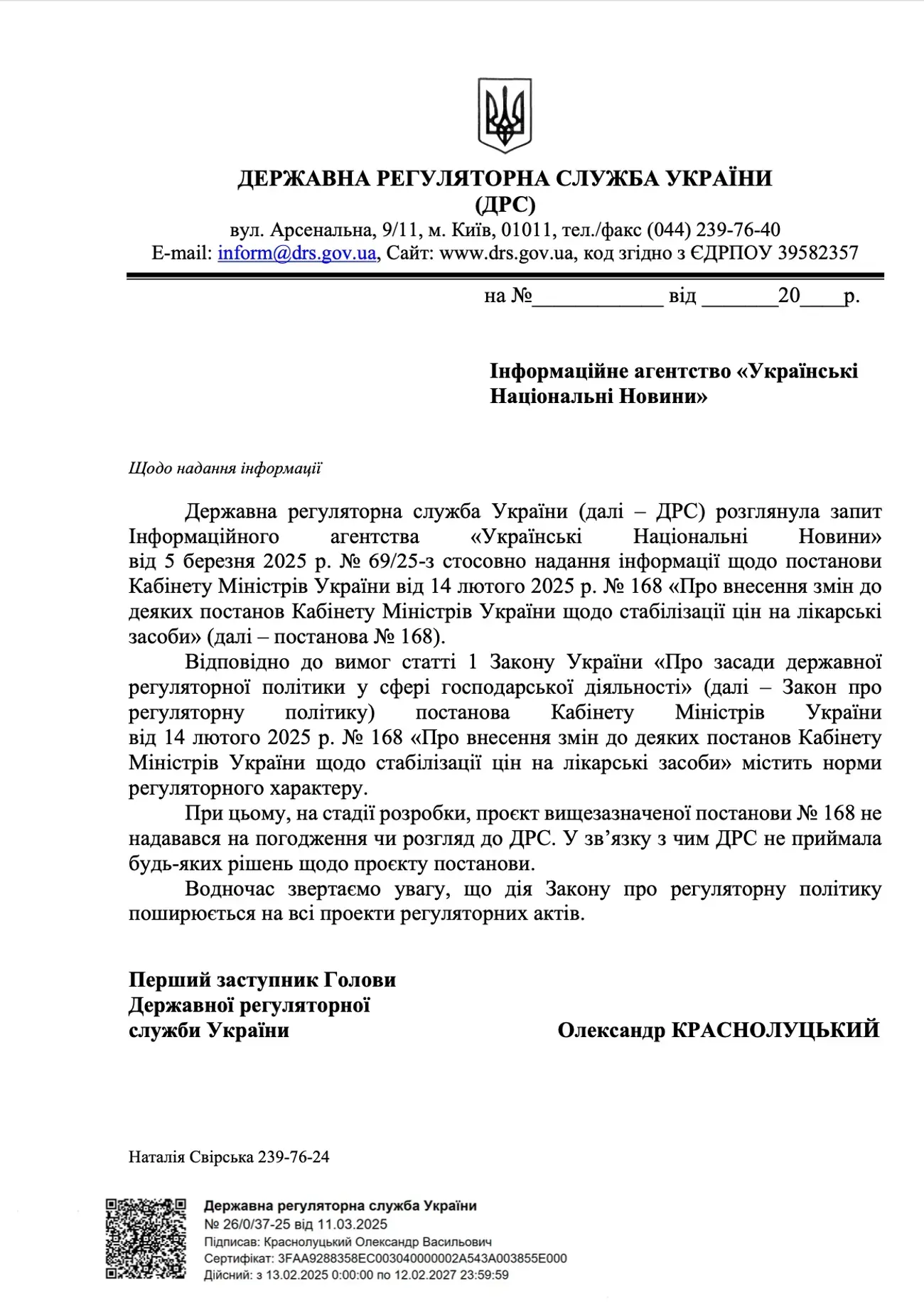
The State Regulatory Service informed UNN that the draft resolution adopted by the Cabinet of Ministers of Ukraine on February 14 did not undergo approval with, as provided by law.
At the same time, at the development stage, the draft of the aforementioned resolution No. 168 was not submitted for approval or consideration to the SRS. In connection with which the SRS did not make any decisions regarding the draft resolution
At the same time, the service emphasized that the law on regulatory policy applies to all draft regulatory acts.
Recall
Cabinet of Ministers of Ukraine Resolution No. 168 of February 14, 2025, provides for new rules for regulating the pharmaceutical market. In particular, restrictions were introduced on markups for supply and distribution and retail markups for all medicines, and not just for certain categories. In addition, the resolution prohibits retail from entering into marketing agreements with pharmaceutical manufacturers, which allowed pharmacies to offer discounts to patients, implement social projects, and conduct training for pharmacists.
The purpose of the resolution was to reduce drug prices and increase their availability to the population. At the same time, patient organizations warned that excessive regulation could lead to a shortage of medicines, the closure of pharmacies in small towns and villages, and the cessation of social support programs for patients.