









How is the Prosecutor General appointed in EU countries and why is there no universal procedure?
Kyiv • UNN
European Union countries form the leadership of the prosecutor's office in different ways: in some, the Prosecutor General is appointed with the participation of the government or the Minister of Justice, in others – by the parliament, the President, judicial bodies, or based on the results of a competitive selection. European practice shows that there is no single model for appointing the Prosecutor General in the EU.

Ukraine has been striving for many years to become a full member of the European Union, and to this end, we are, among other things, adapting our legislation to European standards. At the same time, the phrase "European standards" often creates the impression that all EU countries have the same rules for the functioning of state institutions. The procedure for appointing the Prosecutor General proves the opposite: member states use different models, and there is no universal procedure. Read more about how the leadership of the prosecutor's office is formed in the countries of the European Union in the article by UNN.
EU countries can be divided into two large groups. The first is states where the prosecutor's office is an element of the executive branch or is closely integrated into its system. In such countries, the candidacy of the prosecutor general is most often proposed by the government, the minister of justice, the prime minister, or the president. The second is countries where the prosecutor's office functions as a more autonomous institution. In these cases, judicial councils, prosecutorial self-government bodies, or parliament may participate in the procedure.
The candidacy of the Prosecutor General is determined by the executive branch
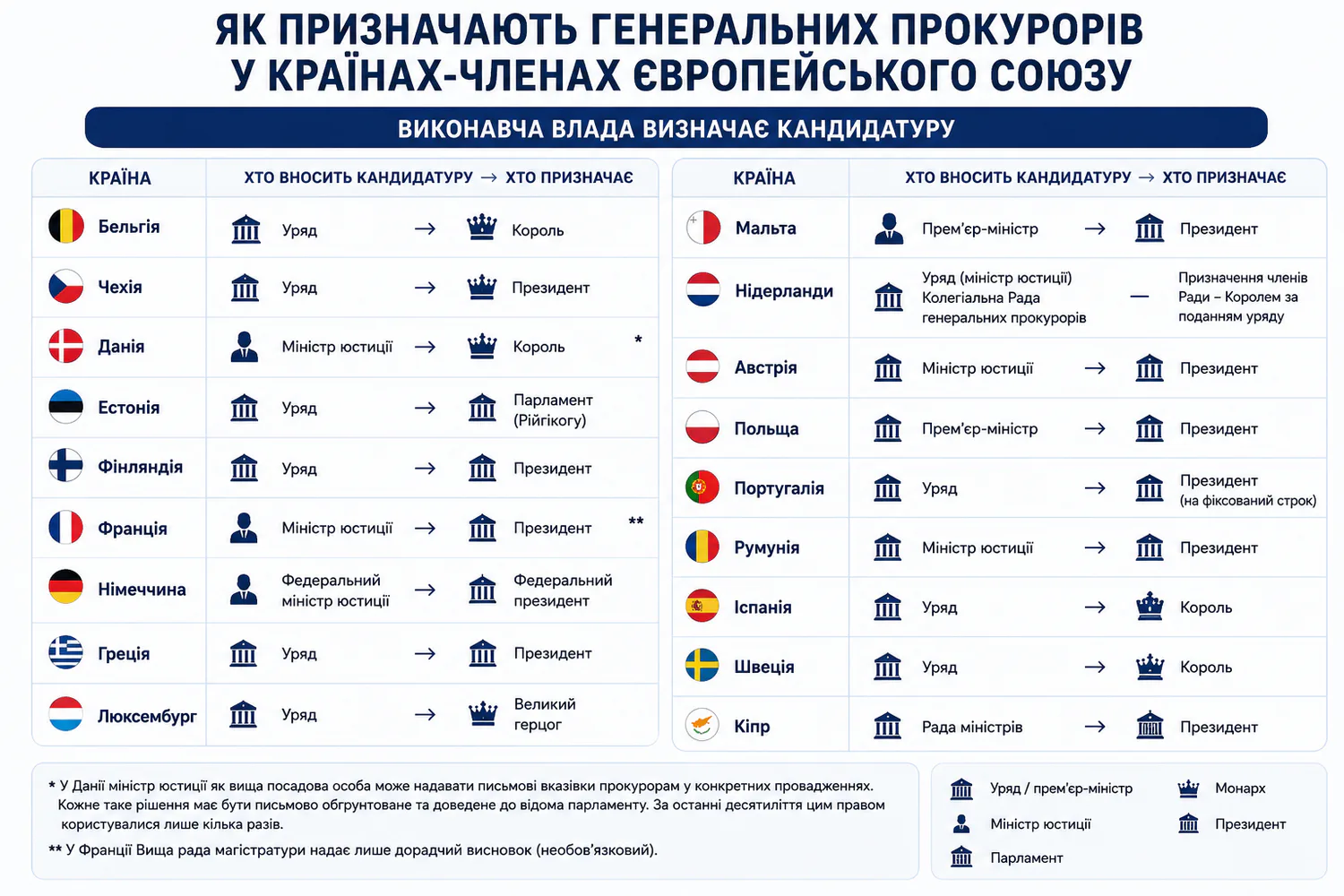
In most member states of the European Union, representatives of the executive branch determine who will be a candidate for the position of prosecutor general. Depending on the country's constitutional model, this may be the minister of justice, the government, the prime minister, or the president. After this, the candidate undergoes an appointment procedure, which usually involves another constitutional body – the president, parliament, or the monarch.
The mechanism resembles the current Ukrainian model in that the final decision is made by political institutions defined by the Constitution. At the same time, the method of submitting the candidacy differs significantly between countries.
For example, in Germany, the Federal Prosecutor General is nominated by the Federal Minister of Justice and appointed by the Federal President. Parliament does not participate in the procedure, and the position itself is traditionally considered political – the prosecutor implements the criminal law policy of the current government.
A similar approach is used in France, where the candidacy is also proposed by the minister of justice and appointed by the President. The High Council of the Judiciary participates in the procedure only by providing an advisory opinion, which is not binding.
In Portugal, the candidacy of the Prosecutor General is proposed by the government, after which it is approved by the President. At the same time, the head of the prosecutor's office is appointed for a fixed term, which is considered one of the guarantees of institutional independence from the current political situation.
However, there are models with their own peculiarities. For example, in Denmark, the minister of justice is the superior official over prosecutors and can even give written instructions to prosecutors in specific criminal proceedings. A safeguard against abuse is the requirement for mandatory written justification of instructions and reporting to parliament. Over the past decades, this right has been used only a few times.
The candidacy of the Prosecutor General is determined by judicial councils, parliament, and competitions
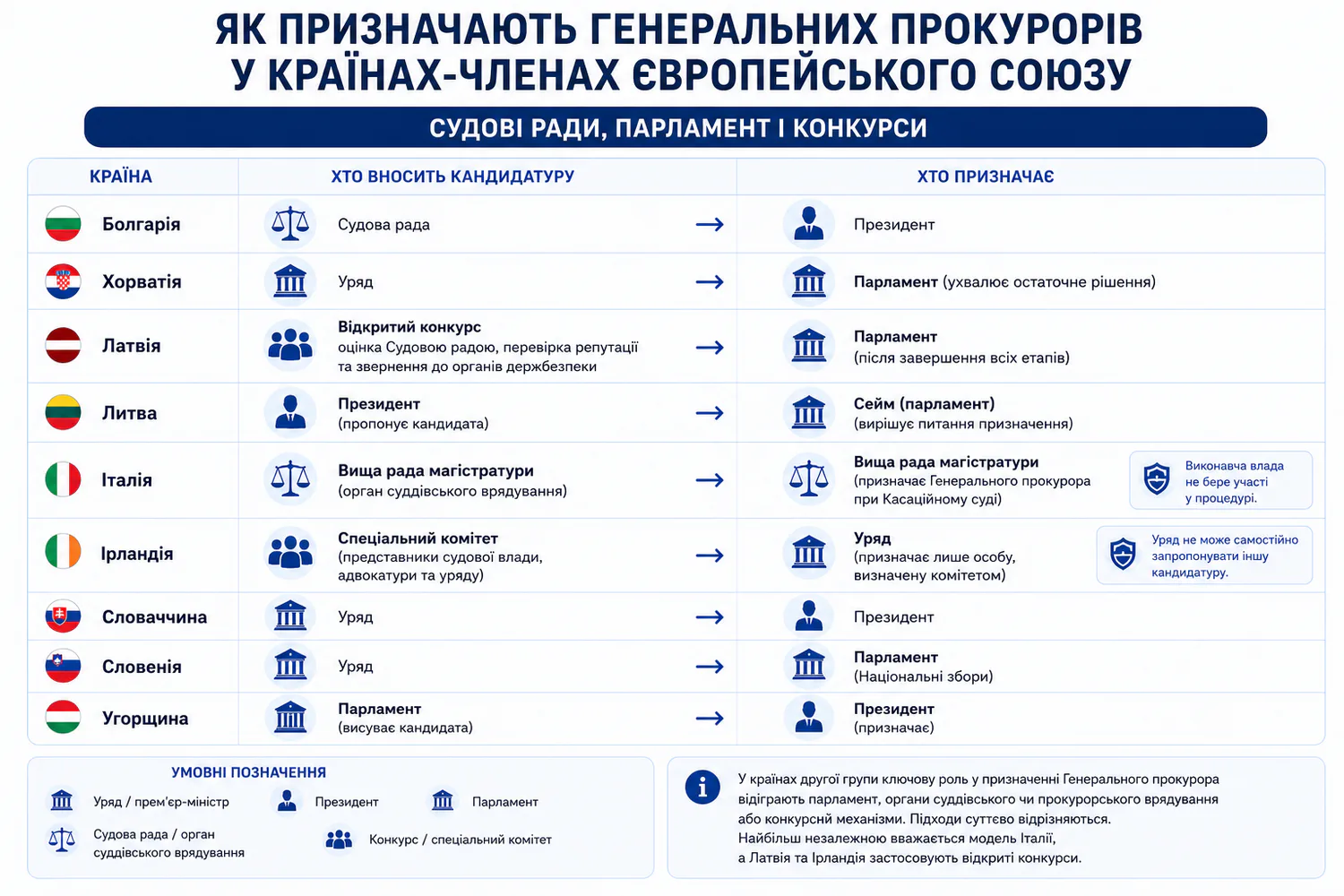
The second group includes states where the decisive role in the appointment of the Prosecutor General is played by parliament, judicial or prosecutorial governance bodies, or competitive mechanisms. At the same time, even among these countries, there is no single approach.
Thus, in Bulgaria, the candidacy is proposed by the Judicial Council and appointed by the President. In Croatia, the government submits the candidacy to parliament, which makes the final decision. In Lithuania, the procedure also involves a division of powers between the President and parliament – the head of state proposes the candidate, and the Seimas decides on his appointment.
And in Italy, both the nomination and appointment of the Prosecutor General at the Court of Cassation belong exclusively to the High Council of the Judiciary, i.e., the judicial governance body. The executive branch is effectively removed from the personnel procedure. At the same time, this very model has repeatedly been the subject of criticism due to internal conflicts and struggles for influence within the judiciary itself.
Latvia and Ireland attract particular attention, as they are most often cited as examples of states where the Prosecutor General undergoes an open competitive selection. In Latvia, candidates submit documents for an open competition, after which they are evaluated by the Judicial Council, which conducts a reputation check and contacts state security bodies. Only after all stages are completed is the candidacy submitted to parliament. In Ireland, the selection is carried out by a special committee consisting of representatives of the judiciary, the bar, and the government. At the same time, the government cannot independently propose another candidate – it appoints only the person determined by the committee.
Why is there no universal model for appointing the Prosecutor General in the EU?
Despite the fact that all states of the European Union are guided by common democratic values and the principle of the rule of law, they have not developed a single model for appointing the Prosecutor General. The reason is that the prosecutor's office system in each country is a component of its constitutional order, which has been formed over decades.
This approach is supported by European institutions. The Venice Commission has repeatedly emphasized that a state has the right to independently determine the model of organizing the prosecutor's office, provided it corresponds to its constitutional order and ensures the independence of prosecutors and the proper functioning of the institution. That is why, during the accession of new states to the European Union, there is no requirement to introduce a specific model for appointing the Prosecutor General, in particular a mandatory open competition.
The Consultative Council of European Prosecutors holds a similar position. In Opinion No. 19 of 2024, it is stated that European states can use different systems for forming prosecutorial bodies depending on their own legal tradition, state structure, and constitutional model. The main criterion is not the method of appointing the Prosecutor General, but the guarantees of his independence, the transparency of the procedure, and the effectiveness of the prosecutor's office.
Recall
A draft law No. 15343 "On Amendments to Certain Legislative Acts of Ukraine Regarding Strengthening the Independence of the Position of the Prosecutor General of Ukraine" has been registered in the Verkhovna Rada. The document proposes introducing an open competition for the position of Prosecutor General, creating a special competition commission that will include both Ukrainian and international experts, as well as changing a number of procedures related to the appointment, disciplinary responsibility, and dismissal of the head of the Office of the Prosecutor General.
At the same time, the proposed model has already become the subject of a broad legal discussion. In particular, experts draw attention to potential constitutional and legal risks of certain provisions of the draft law. Among them are issues regarding the possible narrowing of the constitutional powers of the President of Ukraine when submitting the candidacy of the Prosecutor General to the Verkhovna Rada, expanding the competence of the High Council of Justice beyond its constitutional status, as well as the sufficient certainty of certain procedures.
Lawyers emphasize that the Constitution of Ukraine defines the President and the Verkhovna Rada as the subjects of the appointment of the Prosecutor General, therefore any changes to the procedure must take into account the distribution of powers between state authorities established by the Basic Law.