









A giant reservoir of water, three times larger than all oceans combined, has been discovered deep beneath the Earth's surface
Kyiv • UNN
Scientists have discovered water in the mineral ringwoodite at a depth of 700 kilometers. This discovery proves that oceans could have seeped to the surface from the planet's interior.

A huge reservoir of water has been discovered 700 kilometers beneath the Earth's surface. The water is contained within a mineral called ringwoodite. The volume of water hidden in this deep reservoir is approximately three times the volume of all the planet's surface oceans combined, according to research first published in the journal Science. This is reported by Indian Defence Review, writes UNN.
This discovery directly challenges the long-held theory that water was brought to Earth by comets. Instead, it supports another idea: oceans gradually seeped from the planet's interior over millions of years. The study also suggests that this deep reservoir may act as a natural buffer, maintaining the stability of surface ocean volumes over geological timescales.
A network of 2000 seismometers
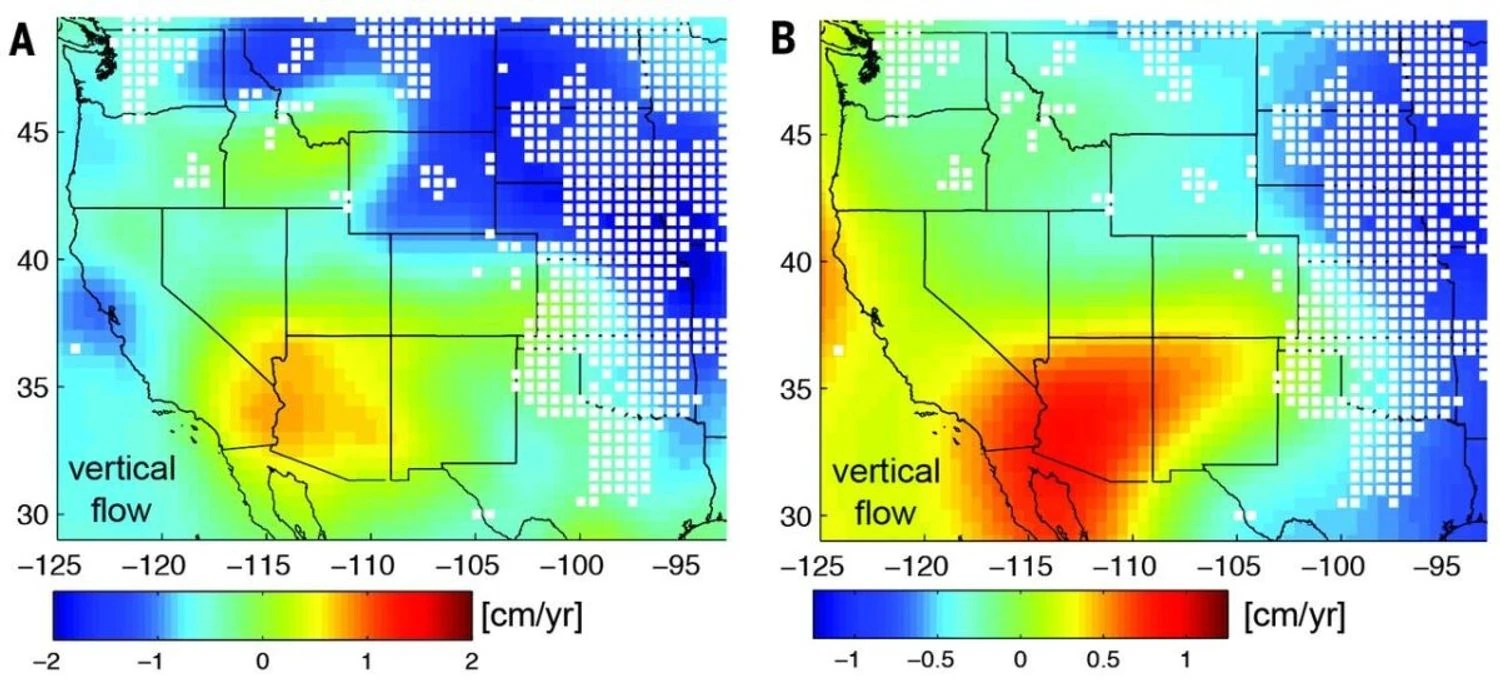
A research team led by geophysicist Steven Jacobsen of Northwestern University used an exceptionally large array of instruments to detect the water. They placed over 2,000 seismometers across the United States and analyzed seismic waves generated by more than 500 earthquakes. Jacobsen noted that these waves cause the planet to "ring like a bell for several days after the event."
As these waves passed through the Earth's interior, their speed changed depending on the type of rock they traversed. When the waves moved through water-bearing rock, they slowed down significantly. This deceleration suggested to Jacobsen's team that the transition zone—a mantle layer 700 kilometers deep that separates the upper and lower mantle regions—contains a significant amount of water locked within ringwoodite.
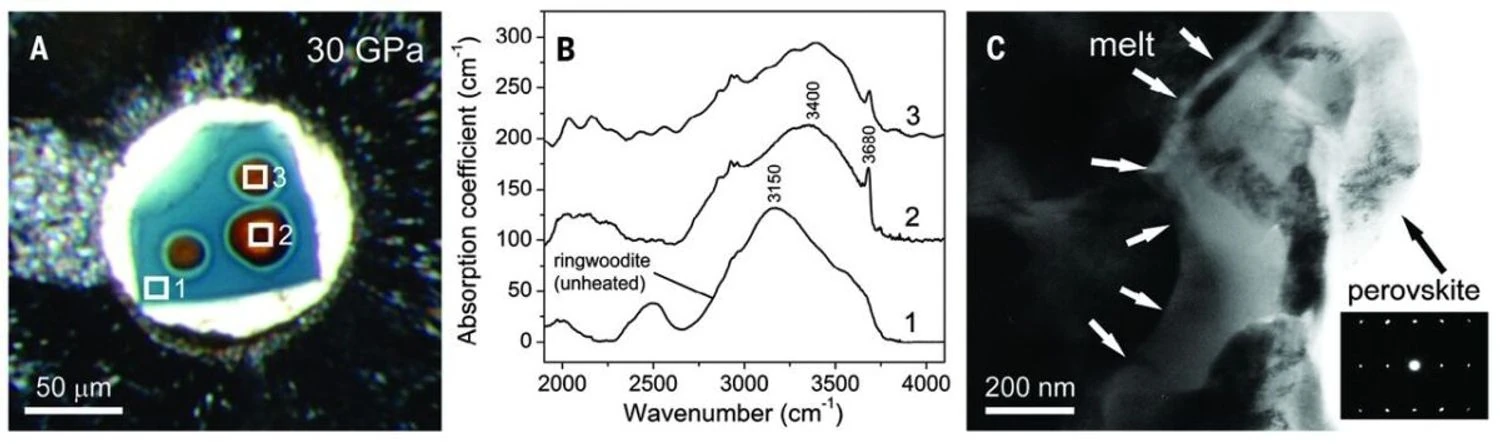
Jacobsen also confirmed this finding in his laboratory. He grew samples of ringwoodite and subjected them to colossal pressures and temperatures corresponding to conditions at a depth of 700 kilometers. Experiments showed that the mineral can indeed hold large volumes of water under such conditions. At this depth, the pressure and temperature are just right to "squeeze" water out of the ringwoodite.
Physical confirmation from a diamond
Seismic data was not the only argument. Graham Pearson, a diamond researcher and director of the School of Diamond Exploration Training and Research at the University of Alberta, provided physical evidence from an unexpected source: a diamond.
This diamond originated in the transition zone and was brought to the surface by a volcanic eruption. Inside it, Pearson discovered a tiny sample of water-bearing ringwoodite. This was the first direct physical evidence of hydrated, or water-bearing, ringwoodite from the deep interior of the Earth. Pearson is one of the world's leading scientists in diamond research and has pioneered methods for dating the smallest geological samples.
"Since our first report of hydrated ringwoodite, we have found another ringwoodite crystal that also contains water, so the evidence is now very compelling," Pearson stated.
Jacobsen described the deep rock as if it were sweating. "It's rock with water along the boundaries between the grains, almost as if they're sweating," he explained.
Natural buffer for the oceans
The discovery changes scientists' understanding of where water on Earth came from. The old "cometary" theory had problems: the chemical composition of cometary water does not fully match the water in Earth's oceans. The deep reservoir provides a more plausible explanation.
"This is strong evidence that water on Earth came from within," Jacobsen emphasized.
The hidden water may also serve as a natural buffer for the surface oceans. Jacobsen suggested that the reservoir could help explain why ocean volumes have remained relatively stable for millions of years, preventing drastic changes in sea level. He noted that without this deep reservoir, much of this water would be on the surface.
"We should be grateful for this deep reservoir," Jacobsen added. "If it weren't there, the water would be on the Earth's surface, and the tops of the mountains would be the only land sticking out."
Connection to heat and tectonics
The reservoir is located in the mantle's transition zone, situated between the upper and lower mantle. At this depth, conditions allow water to slowly move through the rock. According to Professor Frank Brenker, a geophysicist at Goethe University Frankfurt, "these mineral transformations significantly complicate the movement of rocks in the mantle."
The water trapped in ringwoodite likely plays a crucial role in regulating heat and the movement of material between the mantle and the Earth's surface. This can affect tectonic activity and the stability of the Earth's crust over geological timescales.
So far, evidence of wet ringwoodite has been obtained from measurements beneath the territory of the United States. Now, Jacobsen wants to determine whether the deep water reservoir extends across the entire planet.
Artificial intelligence found dozens of hidden planets in NASA data30.03.26, 03:59 • 11659 views