










Russia's economy is barely holding on, the Kremlin can no longer hide the consequences of Ukrainian attacks
Kyiv • UNN
In June 2026, Ukraine struck 11 Russian oil refineries, leading to fuel shortages in two-thirds of Russia's regions. The Kremlin acknowledged the problems but is hiding the true scale of economic losses.

Russia's economy is increasingly suffering from systemic strikes by Ukrainian long-range drones and missiles on strategic infrastructure. While during the first years of the full-scale war the Kremlin managed to isolate most of the population from the economic consequences of the aggression, now the fuel crisis, inflationary pressure, and depletion of reserves are becoming palpable for Russians across the entire country, writes UNN.
Deepstrike and middlestrike from Ukraine
In June 2026, Ukraine significantly increased the intensity of strikes on Russian territory, moving combat operations deep into the enemy's rear. According to the Ministry of Defense of Ukraine, within just one month, 11 Russian oil refineries were hit, 7 fuel logistics facilities, 8 military-industrial complex enterprises, space communication centers, as well as military ships and ferries.
The geography of the strikes covered territory from occupied Crimea and Krasnodar Krai to Western Siberia. Among the most important targets were the Antipinsky Oil Refinery in Tyumen Oblast, the Moscow Refinery, the two largest Bashneft plants in Ufa, the Orenburg Gas Processing Plant, as well as the TANECO and TAIF-NK refining complexes in Tatarstan.
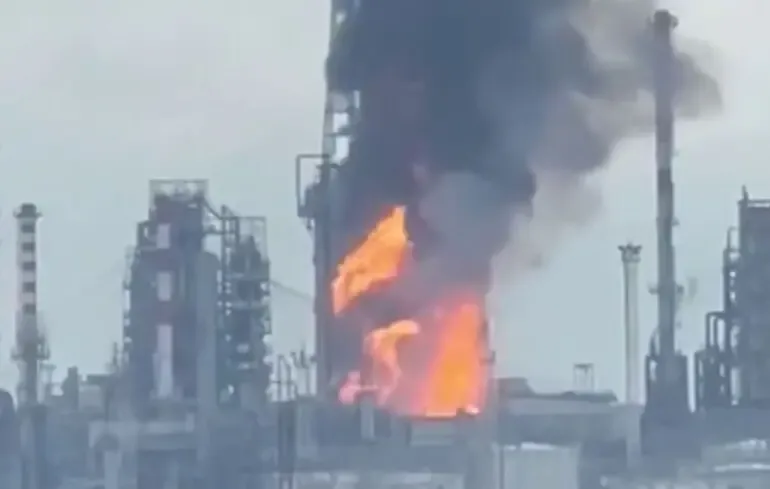
Fire at an oil refinery in Tyumen
The Titan-Barricades plant in Volgograd, which produces artillery systems, launchers, and components for missile systems, was also hit.
July was no exception. In the first days of the month, the SBU struck the Lukoil-Nizhegorodnefteorgsintez oil refinery in Kstovo (Nizhny Novgorod Oblast), which is one of the largest oil refining enterprises in the Russian Federation.
The affected enterprises supply fuel to the Russian army, while others produce components critically needed for the aviation and missile industries. Most of the strikes were carried out by Ukrainian military forces using FP-1 long-range attack drones and Flamingo missiles produced by the Ukrainian company Fire Point.
With the help of medium-range attack UAVs, Ukrainian military forces managed to effectively cut off occupied Crimea from mainland Ukraine, thereby seriously damaging the logistics of Russian troops in the south. Key bridges were destroyed, and facilities that supply fuel to the occupation forces are regularly hit.
The Ministry of Defense emphasizes that the systematic destruction of the oil refining industry and the military-industrial complex directly reduces the military-economic potential of the aggressor state and is one of the most effective tools for pressuring the Russian military machine.
The strikes provoked changes inside Russia
It is these strikes, as noted by the publication Politico, that have begun to change the situation inside Russia itself. The publication writes that for four years, Russian President Vladimir Putin generally managed to shield the population from the economic consequences of the war against Ukraine. Russians were convinced that the "special military operation" was happening somewhere far away. However, this is now becoming increasingly difficult.
According to the publication's assessment, the recent massive attacks by Ukrainian missiles and drones on energy infrastructure facilities have transformed the war from a distant problem that most Russians could ignore into a direct fuel crisis felt by everyone. Fuel supply disruptions are already being recorded in approximately two-thirds of Russia's regions, creating problems for both the population and businesses.
The situation remains particularly difficult in occupied Crimea, where the fuel shortage is already seriously affecting the peninsula's economy.
The Russia-appointed head of the peninsula's occupation administration, Sergei Aksyonov, warned Crimeans that there would be no fuel in the near future.
"Dear Crimeans, the situation with the fuel crisis continues. I ask you to be patient. Large volumes of fuel will not be available for sale in the near future. At the same time, the Ministry of Energy will inform about the situation daily," he stated.
In addition to serious logistical problems due to Ukrainian middlestrikes in occupied Crimea, the tourist season was also disrupted.
The truth can no longer be hidden
The large-scale consequences of Ukrainian attacks have led to the Kremlin no longer being able to completely deny the problem. According to Politico, last week Putin was forced to urgently hold a meeting with government officials over the fuel supply situation. The dictator had to publicly acknowledge that Ukrainian strikes are creating problems for infrastructure, although he continued to insist that the shortage is supposedly not critical.
At the same time, as the publication emphasizes, the Russian authorities are increasingly hiding the true scale of economic losses. For example, data on domestic fuel prices is no longer published. But hiding the crisis is becoming increasingly difficult, as Russians regularly post messages and videos on social media about long queues at gas stations, conflicts between drivers, and gasoline shortages.
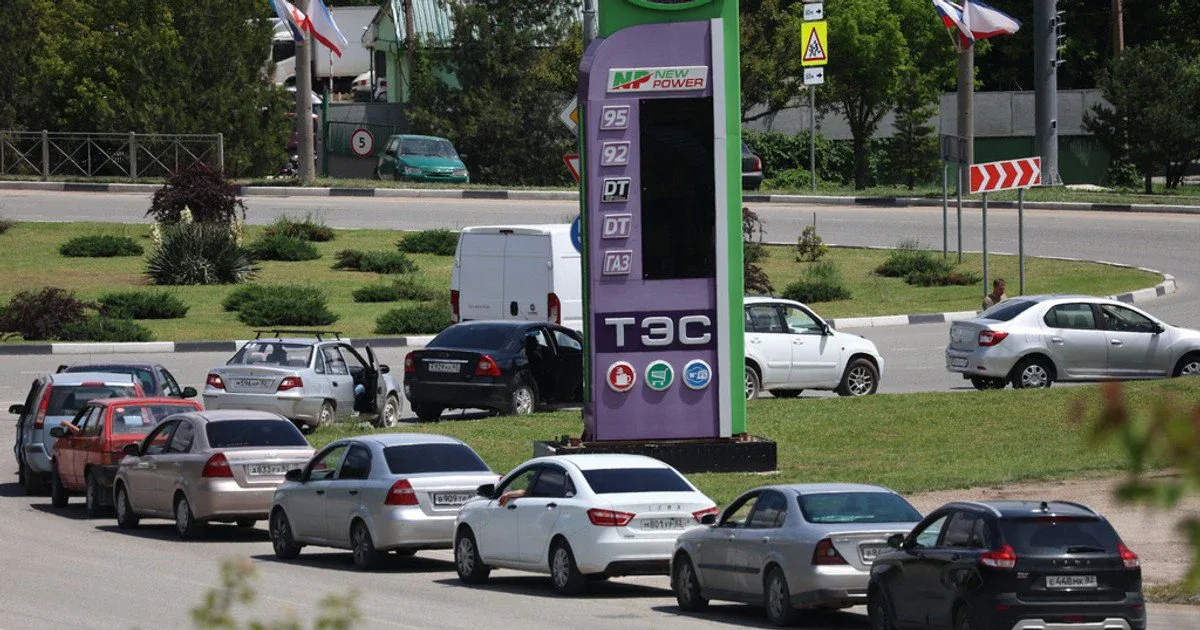
Journalists suggest that the key reason for the current problems is not just strikes on fuel storage tanks, but the targeted destruction of the most technologically complex elements of oil refineries – catalytic cracking units. These units ensure the production of gasoline and other light petroleum products. And due to sanctions, Russia cannot quickly replace or repair such equipment.
For now, the only positive for the Kremlin is that the country still has enough diesel fuel, which is essential for both freight transportation and agricultural machinery. However, Russian officials have already warned that the government may impose a ban on its export to guarantee supplies before the start of the harvest. At the same time, a ban on the export of aviation kerosene and gasoline has already been imposed.
As noted by Carnegie Institute analyst Sergei Vakulenko, the volume of available gasoline in Russia today is determined by "a race between Ukrainian drones and Russian repair crews."
"If the frequency of Ukrainian attacks can be maintained, and the damage from each strike increased, then the advantage shifts to Kyiv. This is exactly what we are seeing now," he noted.
Not just fuel
The crisis in Russia is already extending far beyond the fuel market. The rise in fuel prices is increasing inflationary pressure, forcing the Central Bank of the Russian Federation to maintain a tight monetary policy. According to Politico, this situation is causing increasingly sharp disputes between the leadership of the Russian Central Bank and the largest state banks over the need for faster interest rate cuts.
The state of Russia's public finances is also deteriorating. Military and classified expenditures are already approaching half of all budget spending, while the liquid part of the Russian National Welfare Fund has shrunk over four years of war from approximately 7% to 1.7% of GDP. This means the Kremlin is increasingly financing the war through new debt and budget deficits, the journalists emphasize.
So it is obvious that the intensification of attacks on Russian territory using long-range UAVs and missiles is already having a strategic economic effect. In Russia, not only is fuel running out, but the financial resources with which the Kremlin, among other things, supports the war against Ukraine, are also rapidly being depleted.